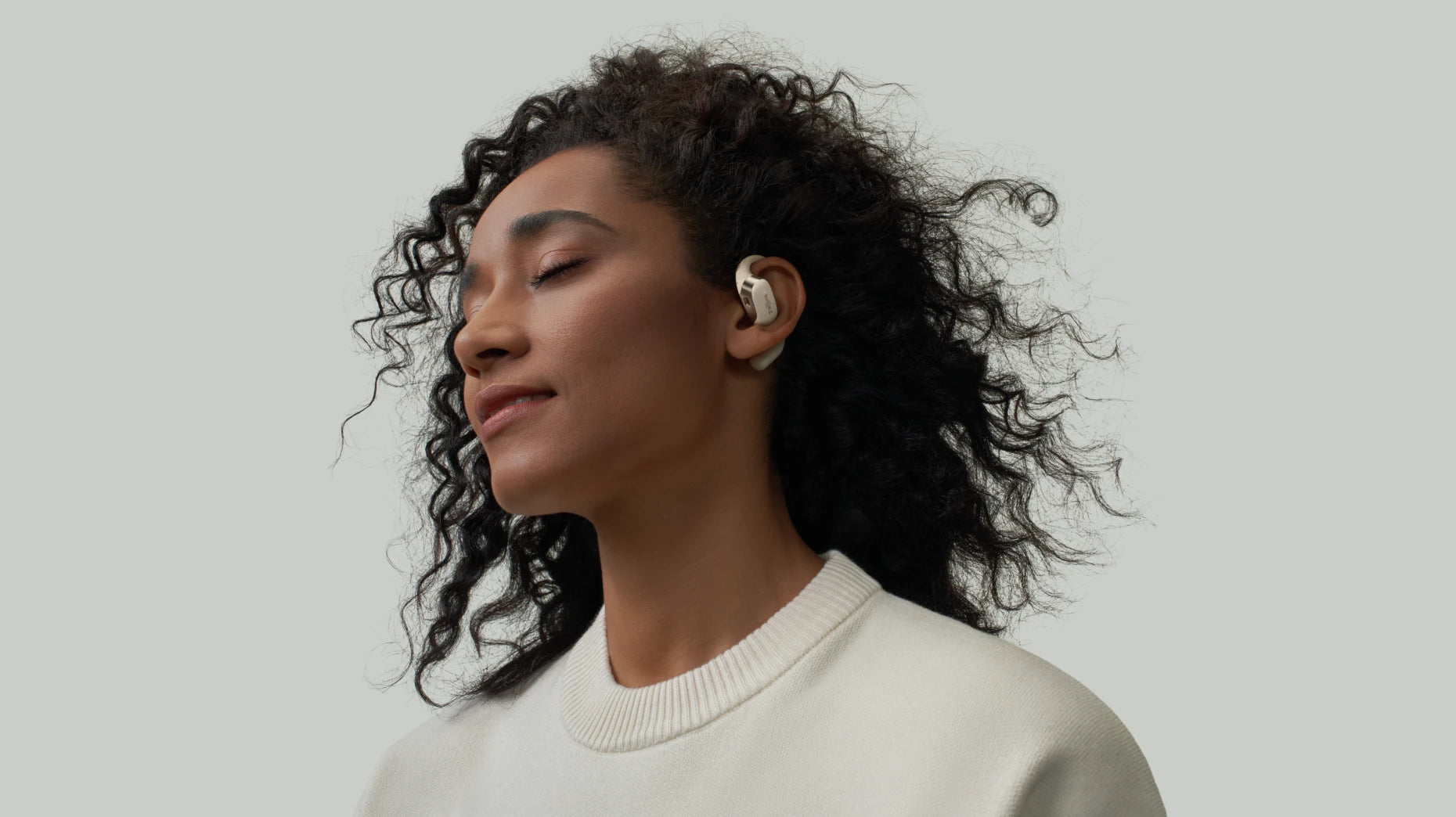
15 years of open listening—How Shokz used open-ear headphones to redesign our relationship with sound
Opening
6:30 in the morning. A running path by the river. Your favorite music is playing through your headphones. And yet, you’re still taking in the wind, the river, and the bicycle bell approaching from behind.
You don't pause the music, nor do you take off your headphones. You simply step half a pace to the side and allow the bike to pass. [1]
Hearing your music and the world at the same time feels unremarkable today. It was once dismissed as a technology with no future.
Shokz spent fifteen years turning it from a technology few believed in into an entirely new way of living openly with sound.

A choice nobody believed in
The beginning of Shokz was simple–a few engineers, a small headphone company, and a technology few believed in.
In 2007, they decided to set the original business aside and stake everything on what mattered more. The bet was bone conduction.
At the time, the industry's view on bone conduction was overwhelmingly pessimistic. Thin sound, sound leakage, a skull that buzzed at high volume, heavy power consumption. The odds of turning it into a viable consumer product looked close to zero.
What Shokz's founders saw was something different.
Traditional headphones seal the ear canal, keeping music and ambient sound out together. Bone conduction takes another route. Sound travels through the temporal bone to the inner ear, leaving the ears open.
With headphones on, you can still hear the bicycle bell behind you.
For people in motion, that wasn’t the point of the technology. The point was being able to wear headphones comfortably for longer periods while staying connected to the world around you.
So Shokz went to work.
One technology. Fifteen years.

In 2011, the consumer brand AfterShokz was founded in the United States. The following year, its first product, Sportz, received The Wall Street Journal's Innovation Award. It was the only consumer electronics product to win that year, and the first time a company from mainland China received the award. [2]
Bluez followed as the first bone conduction Bluetooth headphones, and Shokz products soon reached the shelves of Apple and Best Buy.
In 2021, the brand was renamed. AfterShokz became Shokz.
Another set of numbers tells the story of how the industry came to see Shokz. Ten CES Innovation Awards® between 2013 and 2026; more than 20 international design and media honors, including the iF Design Award, Red Dot Award, Good Design Award, IDEA, Edison Awards; and the only open-ear headphone on TIME's Best Inventions list. [2]
Behind these awards is a commitment to continual innovation—one that helps users enjoy more balanced, comfortable sound while keeping their ears open to the world around them.
Every time the industry raised a question about open-ear headphones, Shokz answered with a product. Again and again. Right up to today.
Three ways to define open-ear listening
There are many stories to tell about fifteen years of Shokz. This one focuses on three.
First, how round after round of innovation made bone conduction world-leading. [3]
Second, how open acoustics moved beyond the behind-the-neck bone conduction form and into more moments of everyday life.
Third, how Shokz pushed past the category's technical limits to expand what open acoustics can do.

1.Building a new way to listen with bone conduction
Start with what bone conduction actually is.
Traditional headphones send sound through the air. Sound waves enter the ear canal, move the eardrum, and travel on to the inner ear.
Bone conduction takes a different route. A transducer rests on the temporal bone in front of the ear, converting electrical signals into mechanical vibrations that travel through the skin and bone to the cochlea.
Cover your ears and bite into a cracker. You can still hear the crunch.
Sound has always traveled through bone.
But traveling through bone is one thing. Traveling through it well is another.
Bone conducts low frequencies less efficiently than air, which meant early bone conduction headphones struggled to produce strong bass. The transducer could also vibrate the housing, causing sound leakage. Turn up the volume, and the vibration could become noticeable inside your own skull. The power needed to drive those vibrations also made products heavier and bulkier.
Shokz answered each problem with a technology history written in products.
-
2012 · Sportz · Bone Conduction Technology: for the first time, sound bypassed the ear canal and traveled through bone.
-
2015 · Titanium · PremiumPitch™ 1.0+: less vibration, with sound leakage reduced by 50%. [4]
-
2018 · OpenComm · PremiumPitch™ 2.0: an integrated unit brought more balanced sound and improved water resistance.
-
2019 · Aeropex · PremiumPitch™ 2.0+: the battle against vibration continued.
-
2024 · OpenRun Pro 2 · DualPitch™: two drivers, two jobs. One handles the mids and highs, while the other handles the bass.

From Sportz in 2012 to OpenRun Pro 2 in 2024, four barriers came down one by one– acoustic structure, materials, vibration, and algorithms. The foundation was rebuilt year after year.
That technology journey has two endpoints today.
One is OpenMove, an accessible entry point that gives more people a first taste of open listening. The other is OpenRun Pro 2, the DualPitch™ flagship and the only open-ear headphone on TIME's Best Inventions of 2025 list. [2]
Fifteen years ago, open ears and good sound seemed like an either/or choice. It took Shokz twelve years to answer that question.

2.Taking open-ear headphones beyond the sports field
Bone conduction proved that open listening worked. The next question came right behind it. If open ears are this good, why should they only be for running?
Shokz's answer is written across four product lines. From the running path to the desk, open-ear headphones have spread across the different hours of a day.
-
On the track and in the pool: the OpenRun series, OpenMove, and the OpenSwim series.This is where it all started. Road running and cycling [1], followed by IP68 waterproofing [5] and built-in storage that carried open listening into the swimming lane.

-
In the gym: the OpenFit series, ear-hook headphones designed for strength training and group classes.The latest OpenFit Air 2 weighs just 7.2 grams per earbud. [6] Getting there meant rebuilding the headphones from the inside out. Five major redesigns, more than 150 fine adjustments, and at the end, and an internal titanium support wire ultimately thickened to 0.75 mm. [7]Less weight. A stiffer frame.

-
On the street and in daily life: the OpenDots series, clip-on earbuds that grip the outer ear without an ear hook.OpenDots 2 uses Bassphere™ 2.0 to fit two 11.8 mm drivers into a clip this small, while still delivering bass. Open-ear headphones were becoming part of the outfit, not just part of the workout.

-
At the desk: OpenComm2 and OpenMeet2, optimized for long calls and meetings.Because work hours shouldn't mean disconnecting from the world.

Four product lines. Four forms. One idea behind them all:
Open listening should fit into more of life.
3.Expanding what open-ear headphones can do
The third challenge is the hardest.
Open-ear headphones carry a built-in contradiction. Their core value is leaving the ear canal open. But the industry's standard noise-canceling technology, ANC, is designed around the opposite–a sealed ear canal and an enclosed acoustic chamber.
Openness and quiet seem to work against each other.
The industry has viewed it as a wall. Shokz sees it as an opportunity to explore.
In January 2026, OpenFit Pro launched at CES, introducing Shokz's first headphones built around Open-Ear Noise Reduction.

The work took three years. The final testing ground was the subway, where trains accelerate and brake, doors open and close, and noise keeps shifting between high and low frequencies.
Thousands of user tests. More than 10,000 individual ear measurements.
And even then, the original driver design was overturned in June 2024.
In its place came the Shokz SuperBoost™ dual-diaphragm. The launch slipped by more than half a year, while 81 venting configurations were tested one by one.
What finally emerged was a three-microphone array paired with an ear-adaptive algorithm, reducing background noise without sealing the ear canal.
Café chatter recedes into the background. The clank of gym equipment becomes less intrusive. But a car horn, a coworker calling your name, and the ambient sounds worth noticing remain audible. [8]
Shokz doesn’t call it ANC. It's called Open-Ear Noise Reduction.
The modest name is deliberate, because the goal was never to shut the world out.
Traditional headphones made you choose between immersion and awareness, between isolation and freedom.
OpenFit Pro offers a third option.
The next 15 years
The question fifteen years ago was whether an immature technology like bone conduction could become a consumer product.
Today there is an answer.
Shokz has built open-ear into the world's best-selling sports headphone category. [9]
So what is the question for the next fifteen? I think the most important one is still this: How should people live with sound?
No one should have to seal themselves inside a silent bubble. Part of your hearing belongs to the music you love, your conversations, and your moments of focus. The rest belongs to this vivid, constantly moving world around you.
Over the next fifteen years, Shokz will move in two directions. First, continue pushing open acoustics itself, toward fuller sound, lighter designs, and smarter open-ear noise reduction.
Second, as a forward-looking technology company, we continue to explore the potential at the intersection of AI and acoustics, with applications spanning the office, focus, and health.
Open-ear headphones have a natural advantage here because they can be worn comfortably throughout the day. [10] A watch needs you to lift your wrist. A phone needs to come out of your pocket.
But headphones are already on your ears. From the morning meeting to the subway ride home, they can stay there.
Technology will keep moving, but perhaps it should move in one direction only: Headphones that are less a wall, and more a window.
Fifteen years ago, Shokz redesigned a pair of headphones. Over the next fifteen years, what gets redesigned is the relationship between people and sound.

Footnotes
[1] Always wear headphones securely and adjust the volume to maintain awareness of your surroundings during outdoor activities. Using headphones while cycling or driving can significantly impair your ability to hear traffic, potentially leading to accidents. It may also violate local laws and regulations. Please ensure you comply with all local traffic laws and regulations when using this product.
[2] All awards referenced in this article are verified award records. The Wall Street Journal Innovation Award, 2012. Ten CES Innovation Awards®: two in 2013, one each in 2014 and 2016, two in 2018, one in 2020, one in 2025, and two in 2026. Edison Awards Gold, 2014. IDEA Bronze, 2015. Red Dot Award, 2016. Good Design Award, 2016–2019 and 2025. Nine iF Design Awards: two in 2020, one in 2021, two in 2023, one in 2024, one in 2025, and two in 2026. VGP, 2019, 2020, 2023, and 2024. TIME Best Inventions, 2025, the only open-ear headphone on the list.
[3] "World-leading" refers to global shipment volume in the open-ear headphone category. According to Omdia, Shokz ranked first among open-ear headphone brands worldwide in shipments for three consecutive years (2023–2025).
[4] The 50% reduction in sound leakage is relative to the previous generation of the technology (the fourth generation of LeakSlayer™, released in 2013). Data was gathered from testing under controlled laboratory conditions.
[5] OpenSwim Pro can be submerged in up to 2 meters of fresh water. OpenSwim Pro was tested under controlled laboratory conditions and has a rating of IP68 under IEC standard 60529. The water-proof properties of this product are not permanent and may decrease over time due to normal wear and tear.
[6] Data was gathered from Shokz Lab and the specific weight may vary by ± 0.2 grams.
[7] 0.75 mm titanium wire data gathered from Shokz Lab.
[8] Noise reduction performance varies depending on ear shape, how the headphones are worn, and the noise level of the environment. The actual experience differs across users and scenarios.
[9] Data source: Euromonitor International (Shanghai) Co., Ltd. Based on global retail sales of sports headphones by brand in 2025, with volume counted in units of 10,000. "Sports headphones" refers to headphones designed specifically for sports scenarios. The survey was completed in April 2026.
[10] Due to differences in ear shape and individual physiology, the wearing experience and level of comfort vary from person to person.